
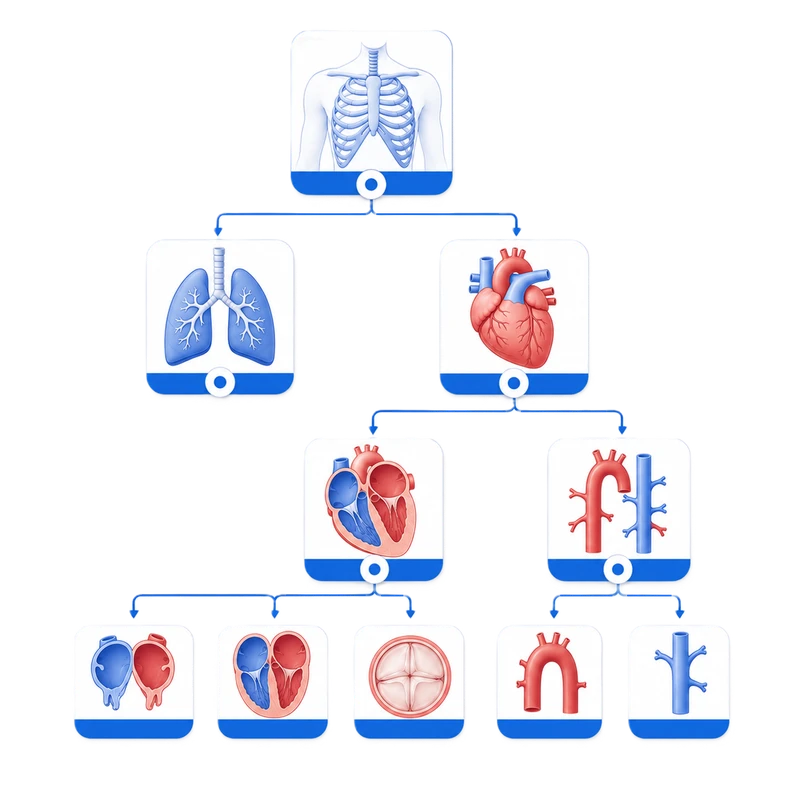
Machine learning classification is a fundamental component of modern AI systems, supporting applications such as medical image analysis, natural language processing, and automated decision support. However, many real-world classification problems do not fit neatly into traditional approaches.
In healthcare, classification tasks may involve hundreds of possible categories, hierarchical relationships between classes, mutually exclusive labels, and highly imbalanced datasets. Traditional binary, multiclass, and multi-label approaches can struggle to represent these complexities effectively.
The Multiplex Classification Framework introduces a novel way to design classification systems for scenarios involving large numbers of classes and logical relationships between them. By restructuring a complex problem into a modular ensemble of specialized models, the framework provides a scalable and flexible foundation for challenging machine learning tasks.
Beyond Traditional Classification Approaches
Most machine learning classification problems are addressed using one of three common approaches.

Binary Classification
Predicts one of two possible classes, such as positive or negative, present or absent, or normal or abnormal.
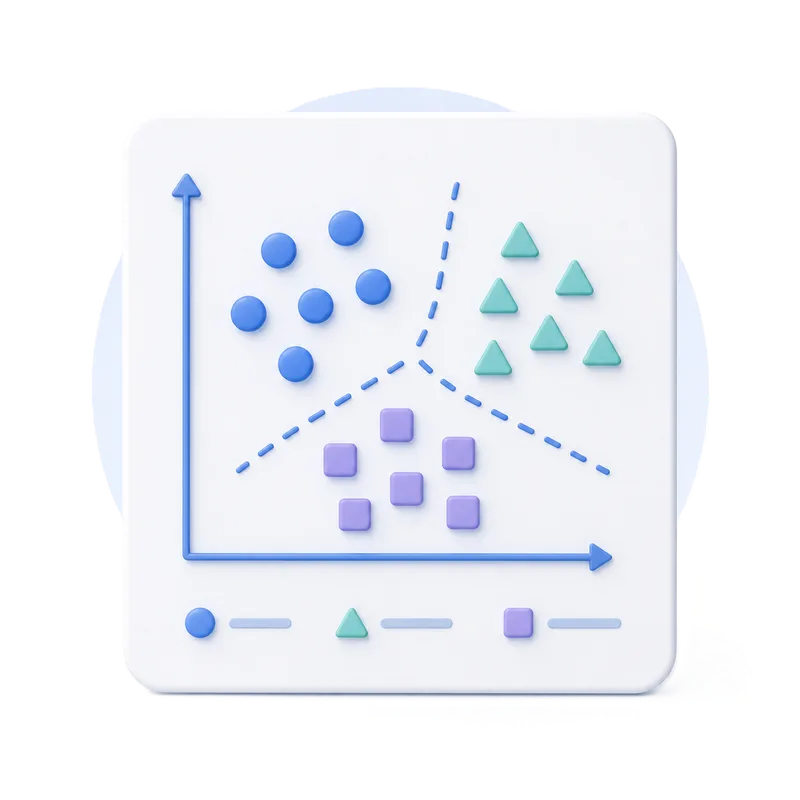
Multiclass Classification
Assigns a single class from a set of mutually exclusive categories.

Multi-Label Classification
Assigns multiple labels to the same sample, usually treating each label as an independent prediction.
These approaches work well for many applications. However, they become increasingly difficult to use when a taxonomy contains many classes, structured dependencies, and rules governing which labels may coexist.
Why Complex Problems Need a Different Approach
Healthcare classification problems frequently combine several sources of complexity that cannot be represented effectively through a flat list of independent categories.
- Large numbers of classes: medical datasets may include hundreds or thousands of possible diagnostic, anatomical, or imaging categories.
- Hierarchical relationships: classes may be organized into parent–child structures, where specific findings belong to broader categories.
- Logical constraints: some labels are mutually exclusive, while others imply, include, or depend on additional classes.
- Severe class imbalance: common categories may contain thousands of examples, while rare but important classes have very few.
- Need for clinically consistent predictions: model outputs must respect domain knowledge and avoid combinations that are logically or clinically invalid.
For example, a medical imaging taxonomy may contain hundreds of findings organized by imaging modality, anatomical region, and disease category. Some findings can coexist, while others are incompatible. A classification system must therefore learn not only which classes are possible, but also how those classes relate to one another.
Addressing Complexity in Machine Learning Classification
The Multiplex Classification Framework transforms a complex classification problem into a collection of smaller, interconnected classification tasks.
Instead of training one model to predict every possible class simultaneously, the framework uses the underlying taxonomy to divide the problem into specialized classification models. These models operate on specific subsets of classes and decisions, then combine their outputs through predefined logical rules.
Framework Architecture
From a large taxonomy to a constrained combined output
The framework decomposes one large prediction problem into modular tasks that can be trained independently and combined consistently.
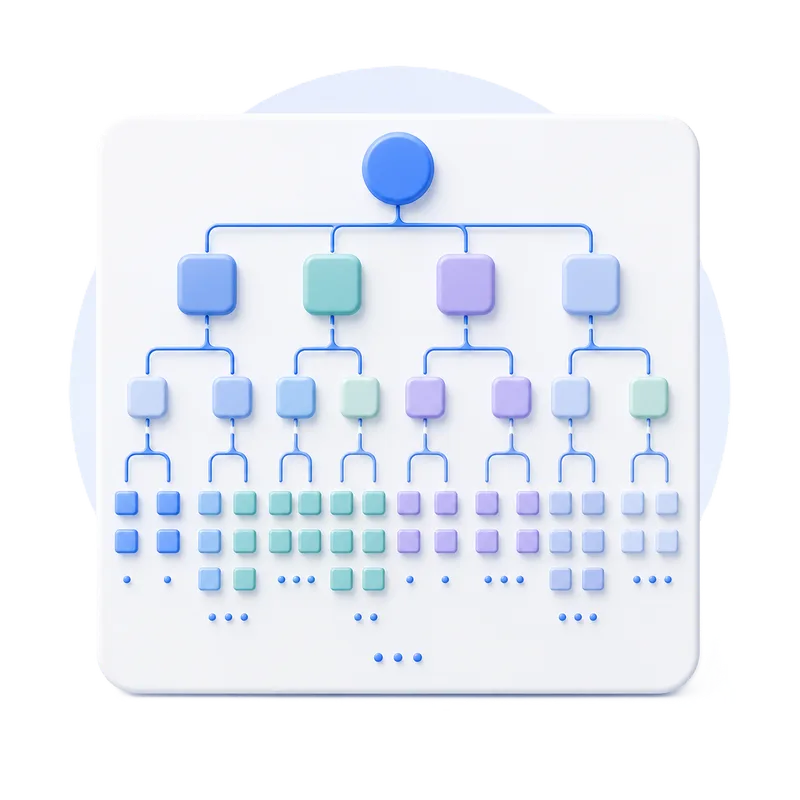
Large Structured Taxonomy
The original set of classes is organized according to hierarchical relationships, exclusivity rules, and other domain constraints.

Specialized Classifiers
Multiple models independently handle smaller subsets of classes and specific decisions within the taxonomy.

Constrained Combined Output
Logical rules combine the predictions and ensure that the final output is consistent with the taxonomy.
This modular architecture allows each component to be optimized for its own classification task. It also separates statistical prediction from taxonomy-level reasoning, making the complete system easier to adapt, extend, and evaluate.
Key Features
The Multiplex Classification Framework combines taxonomy-driven modeling, modular machine learning, and logical constraints to address the limitations of traditional approaches in complex, large-scale classification problems.
Scalable Classification Architecture
The framework supports classification problems with large numbers of classes while maintaining a modular structure. New classes and relationships can be incorporated by updating the taxonomy and the affected classification tasks rather than redesigning the complete system.

Logical Constraint Integration
The framework explicitly represents relationships between classes, including mutual exclusivity, hierarchy, subsumption, and other constraints defined by the taxonomy. This helps prevent incompatible predictions and improves output consistency.

No Confidence Threshold Selection
Traditional multi-label systems commonly require manually selected confidence thresholds to determine whether each label should be accepted. The Multiplex Classification Framework avoids this dependency by representing predictions through dedicated classification tasks.

Improved Handling of Class Imbalance
Dividing a large classification problem into smaller tasks allows individual models to be optimized according to the prevalence, difficulty, and characteristics of their respective classes.

Modular Model Training
Each classifier can be trained and optimized independently. Researchers can select different architectures, hyperparameters, loss functions, and sampling strategies for each component according to the needs of the task.

Open Resources
The Multiplex Classification Framework is openly available for researchers and developers interested in exploring advanced classification approaches.
Research & Implementation
Explore the framework and its application
| Resource | Link |
|---|---|
| Publication in Applied Ontology | Read the publication |
| GitHub repository | View the source code |
| Application example: MultiCaRe Dataset | Explore the application |
Final Thoughts
As AI systems become increasingly complex, many real-world classification problems require approaches that go beyond traditional machine learning paradigms. Flat prediction structures may be insufficient when classes are numerous, imbalanced, hierarchical, or governed by explicit logical relationships.
By combining taxonomy-driven problem decomposition, independently optimized classifiers, and constrained output generation, the Multiplex Classification Framework provides a flexible foundation for developing more scalable and internally consistent classification systems.
The framework is particularly relevant in domains such as healthcare, where predictions must reflect not only patterns in the data, but also the structure, constraints, and knowledge of the clinical domain.
Ready to Explore AI for Your Organization?
Explore how Argenticare can support your goals with AI, data, and automation.