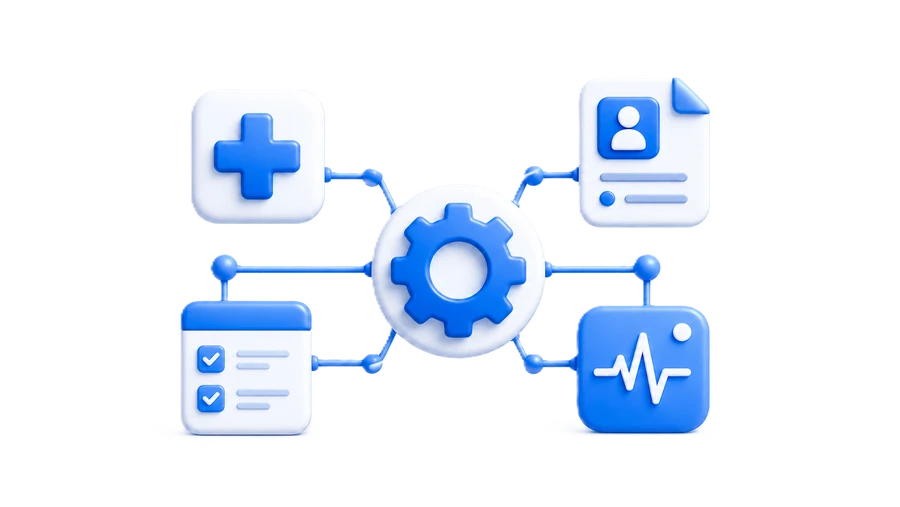
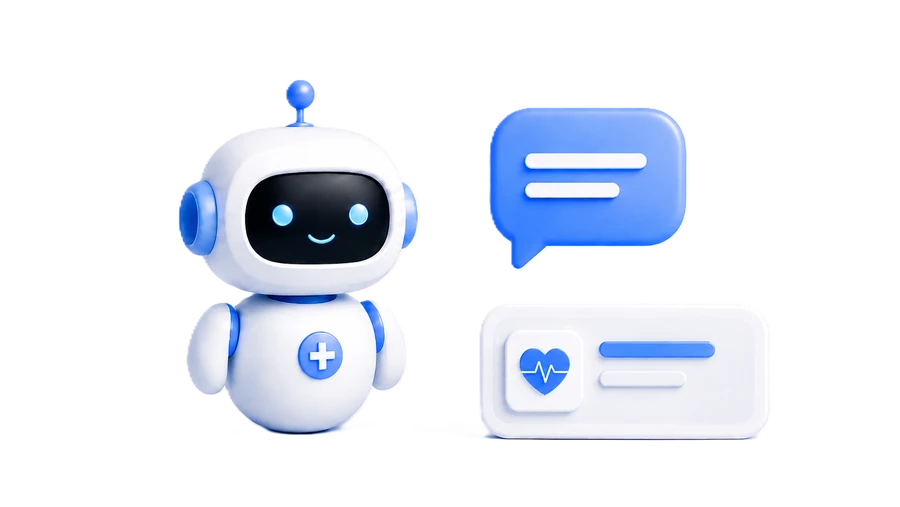
AI assistants are intelligent software applications that interact with users through natural language to answer questions, retrieve information, automate tasks, and support decision-making.
They can support a wide range of clinical and administrative workflows, helping healthcare organizations improve efficiency, reduce manual work, and enhance patient care. In this article, we examine how healthcare organizations use AI assistants and explain the process we follow to design, develop, and deploy them successfully.
Common Use Cases
Healthcare AI assistants can support virtually every stage of the patient journey, along with a broad range of clinical and administrative workflows. These are some of the most common applications we develop.
Patient Triage
Collect relevant clinical information, assess symptoms using predefined protocols, provide guidance, and escalate high-risk cases when appropriate.

Appointment Scheduling & Care Navigation
Help patients schedule appointments, find the right provider, understand referral pathways, and navigate healthcare services.

Follow-Up Care
Deliver post-visit instructions, medication reminders, patient education, and conversational follow-ups based on clinical protocols.

Clinical Decision Support
Provide rapid access to institutional protocols, clinical guidelines, medical literature, medication information, and trusted internal resources.

Clinical Documentation
Assist with clinical notes, summaries, referral letters, patient instructions, and structured documentation while maintaining clinician oversight.

Administrative Support
Answer organizational questions, retrieve internal information, and automate repetitive processes related to billing, insurance, and operations.
Our Approach to AI Assistant Development
Developing a successful healthcare AI assistant requires much more than selecting a language model or writing prompts. Every project begins with a thorough understanding of the organization’s goals, users, and workflows.
We follow a structured development process that prioritizes reliability, security, usability, maintainability, and seamless integration with existing systems.
End-to-End Process
From initial discovery to continuous improvement
Each phase builds on the previous one, reducing implementation risk and ensuring that the final solution remains aligned with real clinical and operational needs.
-
Step 1
Discovery & Requirements
We work with stakeholders to understand the organization’s objectives, users, workflows, constraints, and success criteria. We define the problems the assistant should solve, its target audience, and how it will fit into existing clinical and operational processes.
These requirements are translated into a practical roadmap covering capabilities, conversation scope, knowledge sources, system integrations, regulatory requirements, security considerations, and technical architecture.

-
Step 2
Conversation Design
We map how users will interact with the assistant, including conversation flows, behavior, tone, information collection, response formats, and escalation pathways for situations that require human intervention.
Prompts, guardrails, structured outputs, and fallback behaviors are then defined to help the assistant provide clear, consistent, and reliable responses across different scenarios.

-
Step 3
Knowledge Base Development
We identify, organize, and prepare the trusted information that will power the assistant. This may include clinical guidelines, institutional protocols, standard operating procedures, patient education materials, internal documentation, and frequently asked questions.
The content is structured and optimized for retrieval, with appropriate metadata and retrieval strategies that help ground responses in accurate, current, and organization-approved knowledge.

-
Step 4
Development & System Integration
We develop the assistant and connect it to the systems required for its intended tasks. Depending on the project, this may include Retrieval-Augmented Generation, EHR systems, scheduling platforms, databases, APIs, messaging services, or other third-party applications.
Throughout development, we prioritize security, scalability, maintainability, and reliable interaction with existing clinical and operational workflows.

-
Step 5
Testing & Validation
Before deployment, we evaluate conversation flows, retrieval quality, response accuracy, edge cases, safety controls, and system integrations across realistic scenarios.
Testing is iterative. Prompts, retrieval strategies, and workflows are refined using evaluation results and stakeholder feedback until the assistant performs reliably within its intended scope.

-
Step 6
Deployment & Continuous Improvement
Once validated, the assistant is deployed through the appropriate channel, such as a website, patient portal, messaging platform, mobile application, or internal healthcare system.
After launch, performance is monitored and the solution continues to evolve through knowledge-base updates, prompt refinement, workflow optimization, user feedback, and the addition of new capabilities.

Plans & Pricing
Choose a starting plan based on the assistant’s capabilities, knowledge requirements, system integrations, and level of customization. Final scope and pricing are confirmed after an initial discovery call.
Clinical Chatbots & AI Assistants
A starting point for different assistant capabilities
Plans can be adapted according to conversation complexity, knowledge sources, integrations, channels, and organizational requirements.
Basic
A focused AI assistant for FAQs, basic inquiries, and clearly defined conversational tasks.
From USD 2,000
Standard
Advanced conversation flows, trusted knowledge-base integration, and one system integration.
From USD 6,000
Advanced
Custom assistants with multilingual or voice capabilities, action execution, and integrations as needed.
Custom quote
Building Reliable Healthcare AI Assistants
A successful healthcare AI assistant is not defined only by the language model behind it. Its value depends on how well it understands the intended workflow, retrieves trusted information, integrates with existing systems, and supports users without operating beyond its defined scope.
At Argenticare, we combine healthcare-domain expertise with end-to-end technical development to turn promising ideas into practical AI assistants. From initial discovery to production deployment, every solution is designed around the organization’s goals, users, workflows, and existing technology environment.
Ready to Explore AI for Your Organization?
Explore how Argenticare can support your goals with AI, data, and automation.